
Scientist "close to the answer" on UFOs found dead from self-inflicted .38 caliber gunshot wound in American Southwest...in 1971. He may have disclosed more than we knew.
James E. McDonald was the first prominent American scientist to call for serious consideration of an extraterrestrial hypothesis for UFOs. Did he outline an interdimensional hypothesis before dying?

Preface
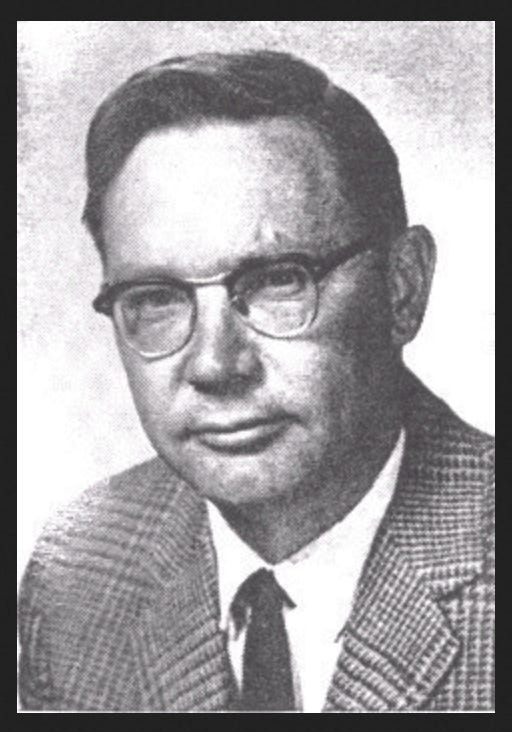
James E. McDonald was an associate director at the Institute for Atmospheric Physics and a professor of meteorology at the University of Arizona until his death in June of 1971. He was also, famously, an early and important figure in the long and winding history of UFO/UAP disclosure. He was the first major American scientist to not only study “the UFO phenomenon” - he was the first such scientist to publicly acknowledge that the U.S. military was mistakenly dismissing and misclassifying numerous witness accounts of UFOs and doggedly risked his professional and personal reputation for years in a scientific pursuit of a greater understanding of the phenomenon and what we call today “Disclosure.”
This article is not going to explore McDonald’s extensive scientific contributions to atmospheric physics and meteorology (e.g., ground-breaking weather modification research) to establish his scientific merit or credibility. You can find that elsewhere, starting with the online archival index graciously maintained by his son, Kirk T. McDonald, Professor Emeritus of Experimental High-Energy Physics in the Department of Physics at Princeton University. Likewise, this article is not going to go into the fascinating history of James E. McDonald’s UFO research, including his examination of Project Blue Book files at Wright-Patterson Air Force Base, his tenacity in the face of the Condon Committee and other official efforts in the late 1960’s to summarily discredit any serious consideration of UFOs, or his own tragic demise in Tucson, Arizona by suicide with a .38 revolver in a desert wash only weeks after telling associates he had been speaking to “high-level” people about the UFO phenomenon and was “close to the answer and would soon be free to speak openly.”1
For the history of James E. McDonald - the rigorous academic, the intrepid investigator, and fearless crusader for UFO disclosure, start with Ann Druffel’s seminal biography, Firestorm: Dr. James E. McDonald’s Fight for UFO Science. It’s worth mentioning that while still alive, Ann Druffel, a very important figure in Ufology in her own right, helped organize and ensure the preservation of McDonald’s extensive UFO files and research in an archive at the University of Arizona, an achievement that we may not know the full value of for many years…or. maybe sooner?
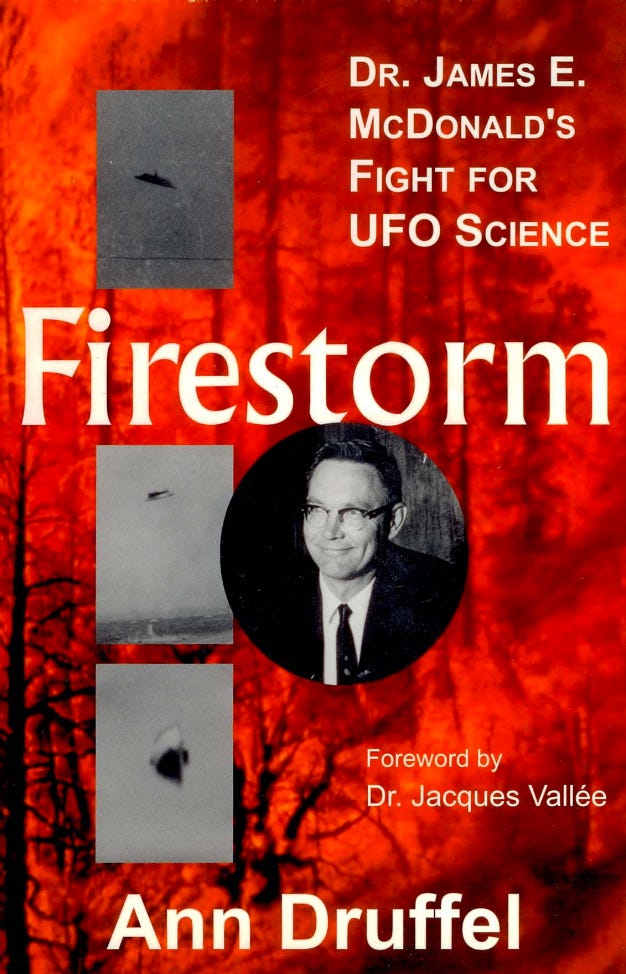
This article really begins where Firestorm leaves off - with certain curiosities, questions - maybe even clues, as it were, transmitted posthumously by James E. McDonald by way of his biographer, Ann Druffel. To be honest, Druffel seemed to know they were clues. It’s as if she, takes her cue from McDonald and points them out to us - even daring us to follow them.
One last paper
In the final weeks of his life, in fact days before his first reported suicide attempt in April of 1971 (and only suicide attempt before successful suicide in June of 1971), McDonald was busy getting all of his UFO files in order. At this time he also finished his last technical paper, “A Variational Derivation of Young’s Equation For the Contact Angle,” a paper on the thermodynamics of phase boundaries. The abstract of the paper reads:
Young’s equation for the contact angle in a solid-liquid- vapor system is deduced,by a straightforward variational method, as the minimum surface free energy equilibrium condition for a small mass of liquid resting on a plane insoluble solid surface. Shape variations are subject to the two constraints of uniform internal liquid pressure, to assure mechanical equilibrium, and constancy of liquid volume under the allowed variations of the shape parameters. The analysis includes a proof that the Young contact angle is not simply an extremal condition on free energy but actually a minimal condition, so that it corresponds to stable equilibrium for the case considered.
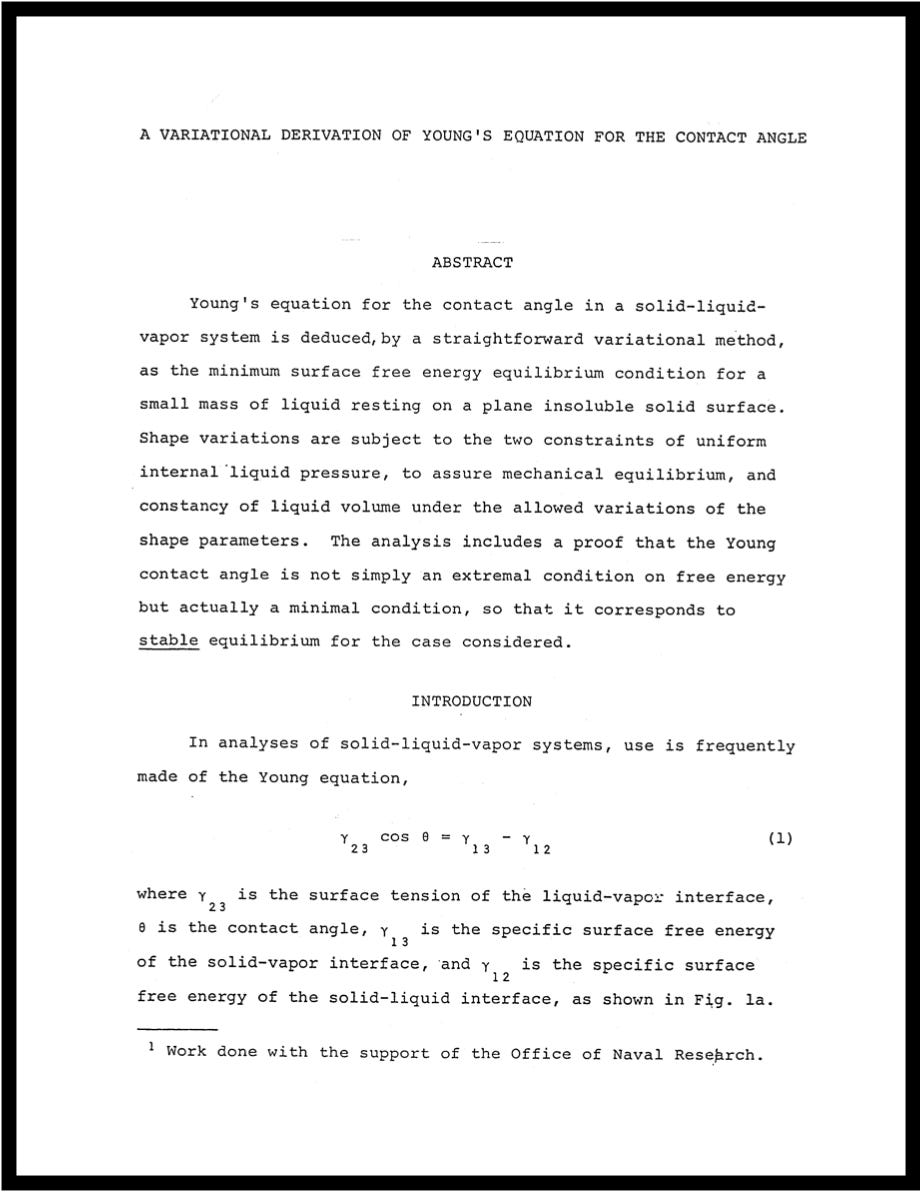
Duffel first hints at the peculiarity of this seemingly dry special case derivation of a well-known equation of thermodynamics, noting McDonald’s own footnote on the first page, “Work done with the support of Office of Naval Research.” Duffel writes, “strangely, none of his colleagues at the Institute [for Atmospheric Physics] who were interviewed for this book remember anything about it.” Duffel continues:
Only Margaret Sanderson-Rae, who typed the final draft, recalls it. It has been shown to several physicists and engineers, but no light has been shed on it. He made one minor correction to the last draft and dated it, in his handwriting, on Monday, March 22, 1971, the next day after he began planning to end his life.
Were these “physicists and engineers” possibly the same “high-level” people McDonald said he was talking to about the UFO phenomenon in regard to te answer he was close to and might soon be able to speak freely about? Duffel continues, and really seems to let the cat right out of the bag, so to speak:
Why did he choose to finish this particular paper, out of 70 unfinished papers in his files? The puzzle is compounded by the fact that the manuscript was found among his UFO materials rather than his atmospheric physics files. In the hope that qualified person(s) might shed some light upon it, it is included as Appendix Item 18-C, page 583. Could this paper possibly have anything to do with the unknown energy involved in UFO propulsion?
And so there it is. Mind you, Duffel was not new to UFO research when she wrote and published Firestorm in 2003. She had a long and considerable background in the field with the benefit of 30 additional years of research, disclosure or not, on the subject since McDonald’s death in 1971.
Head in the ionosphere
But before we get to…it, we need to look at one more clue, one more breadcrumb that Duffel and McDonald have left for us. Just prior to writing that final technical paper, in March of 1971, McDonald focused his attention on ionized layers of nitrogen oxide in the atmosphere. McDonald had a voraciously inquisitive mind that could not be constrained by even a single vast field of science, and while in these last days of his, his letters and writings indicate he continued to be drawn to numerous scientific questions as well as various and necessary bureaucratic matters, Duffel suggests, as with his final paper, there was something peculiar about this one specific focus of McDonald’s:
He was intrigued by the fact that, at about 100 and 175 kilometers altitude, the main positive ion is nitric oxide (NO+): these NO+ layers do not lose their charge by charge transfer. He heavily annotated a copy of Space Physics by Harrie Massey on those pages which refer to these NO+ layers. One of his handwritten annotations emphasized, “NO has lower ionization potential than O₂, O, N, and N₂, while NO+ has highest dissociation potential of any diatomic molecule or ion in [the] atmosphere.
And once again, as before, Duffel really doesn’t hide the clue. She bangs us right on the head with it!
Why did the information about these high-altitude NO+ layers catch his attention so intensely? It does not seem linked to his ozone research, which involved a stratospheric layer much closer to Earth’s surface. Why did he put his copy of Space Physics in his UFO library instead of his even more voluminous collection of atmospheric sciences books? Could his interest have been related to the notion that ionization is possibly associated with UFO propulsion? Positive evidence that ionization is related to UFO propulsion still eludes us, but McDonald’s interest in the NO+ layers should be noted. Perhaps a speculation might be in order here: e.g., are UFOs coming in from space surrounded by NO+?
Did James E. McDonald know about Earth-based interdimensional thermodynamic phase boundary engines…in 1971?
First, why the preoccupation with NO⁺ in the ionosphere?
The most straightforward attraction is the chemical puzzle itself. NO⁺ is anomalously stable - its dissociation energy is, according to McDonald, the highest of any diatomic species in the lower ionosphere. Combined with NO’s unusually low ionization potential, this creates a kind of thermodynamic sink: charge flows easily into NO (it ionizes readily), and once ionized, NO⁺ resists being neutralized by dissociative recombination or charge transfer. A physicist interested in plasma equilibria would find this a beautiful natural laboratory - essentially, the atmosphere has conspired to create an unusually persistent ion layer.
The fact that NO⁺ layers don’t lose charge by charge transfer is the key puzzle. Normally, charge cascades down through ion species via resonant or near-resonant charge transfer. NO⁺ possibly interrupts this cascade - sitting at a potential energy minimum relative to its neutral neighbors. The 100–175 km range brackets the mesopause and lower thermosphere - a region where solar EUV/X-ray energy is deposited, where meteor ablation occurs, and where auroral particle precipitation happens. NO in particular is an important radiative coolant in this region. McDonald have been interested in whether the NO⁺ layers represent a feedback mechanism in atmospheric energy balance.
Perhaps ultimately McDonald was drawn to this problem is what it represents epistemically: here is a natural phenomenon that sits at the intersection of quantum chemistry (why is NO⁺ so stable?), plasma physics (why doesn't charge transfer occur?), atmospheric dynamics (why do the layers persist at specific altitudes?). The fact that the answers to all three questions point to the same molecule is the kind of convergence that suggests something genuinely deep is going on - whether that depth is purely chemical, or points toward something else.
Second, why the urgency for a thermodynamic phase boundary derivation write-up?
Young’s equation determines the equilibrium contact angle of a liquid droplet on a solid surface, balancing solid-vapor, solid-liquid, and liquid-vapor inter-facial tensions. It was developed by Thomas Young in 1805 and is fundamental to understanding surface wetting, hydrophobicity, and capillarity.2
McDonald’s paper's stated purpose is to provide a conceptually clear variational derivation of this equation, and crucially, to go beyond prior derivations by proving that the Young contact angle represents a stable minimum of free energy, not merely an extremal (stationary) condition. The paper goes on to identify “the fallacy of the semi-infinite interface” - the failure to properly constrain the full system when performing virtual variations.
McDonald resolves this by confining attention to a specific, well-defined physical case: a small mass of liquid resting as a spherical cap on a plane insoluble solid surface, with gravitational effects and adsorption neglected. Two constraints are imposed: (1) the liquid-vapor interface must remain spherical at all times during virtual variations, ensuring uniform internal pressure and mechanical equilibrium; and (2) liquid volume must remain constant. These constraints are mathematically encoded, leading to a clean volume-conserving relation between variations in the cap radius r and the contact parameter m = cos θ. Substituting into the free energy variation yields Young's equation as the equilibrium condition, and a subsequent second-variation analysis proves it is a minimum, not merely a stationary point. McDonald’s then novel stability proof within the spherical-cap special case is today a standard variational approach to surface energy minimization in modern surface physics and physical chemistry.
The NO⁺ Atmospheric Layer + Thermodynamic Phase Boundaries
Young’s equation and the contact angle are central to the thermodynamics of nucleation on surfaces. In the upper atmosphere at the altitudes considered by McDonald, heterogeneous nucleation on meteoric dust particles and aerosol surfaces is a real and studied phenomenon. The NO and NO⁺ chemistry at these altitudes is influenced by the surface chemistry of such particles. In that sense, the thermodynamic framework McDonald suggests is a one of minimum free energy conditions for liquid or condensed-phase deposits on solid surfaces.
McDonald’s concern with three-phase boundary conditions and the behavior of systems at the interface between different physical regimes could metaphorically map onto the problem of the ionospheric layer sitting at the boundary between the neutral mesosphere and the ionized thermosphere. The NO⁺ layer persists precisely at a kind of "contact region" between chemical regimes. The NO⁺ layers are, in thermodynamic terms, a stable three-phase boundary condition in the upper atmosphere. It is a system that has found a free energy minimum with respect to charge state, just as a spherical cap on a solid surface finds a free energy minimum with respect to contact angle.
It’s a topology problem
James E. McDonald highlighted (for us?) his interest in properly constrained variational arguments - on not asserting things without proof, on identifying all the constraints before claiming a solution is stable. Based upon his extensive interviews over the course of years with UFO phenomenon witnesses, including many military personnel, McDonald was well aware of reputable craft-like objects performing maneuvers that violate conservation of momentum as he understood it, transitioning between air and water without hydrodynamic shock signatures, accelerating at thousands of g without visible reaction mass, and appearing and disappearing without passing through intermediate positions.
His response would be characteristic: he would not say the physics is wrong. He would say the boundary conditions are wrong - that we are, again, committing the fallacy of the semi-infinite interface, but at a far more fundamental level. Just as inadequate derivations of Young’s equation failed because they treated a boundary as if it existed in isolation from the full system it belonged to, we can imagine that McDonald is proposing that conventional physics fails to account for UFOs because it treats spacetime itself as if it were a semi-infinite, unbounded continuum - when in fact it may have phase structure that we have not correctly characterized.
In his Young’s equation paper, the essential insight was that the contact line is not a passive geometric feature but an active thermodynamic boundary with its own equilibrium conditions, governing the relationship between three distinct phases that coexist at that locus. And so we can now guess at the generalization McDonald was hinting at - namely, what if the NO⁺ layers are not merely an atmospheric chemistry curiosity, but are detectable signatures of a genuine phase boundary in a more fundamental sense - a locus where three distinct physical regimes of spacetime itself are in contact?
Accordingly, explanations of the UFO phenomenon are not descriptions of exotic propulsion - they are descriptions of topological transitions - changes in the connectivity of the object's relationship to the surrounding medium. Like in surface thermodynamics, a droplet on a surface can undergo a topological transition - it can split, or merge with another droplet, or dewet from the surface entirely. These transitions are not described by the same variational equations that govern equilibrium contact angle. They involve barrier crossing - the system must pass through a configuration of higher free energy to reach a new stable state. The energy required for such a transition is related to the geometry of the barrier, not simply to the energy difference between initial and final states.
UFO/UAP transmedium transitions and apparent relocations are the macroscopic signatures of topological transitions in the phase structure of the physical vacuum - analogous to dewetting transitions in surface thermodynamics, but occurring in the medium of spacetime itself rather than on a solid substrate.
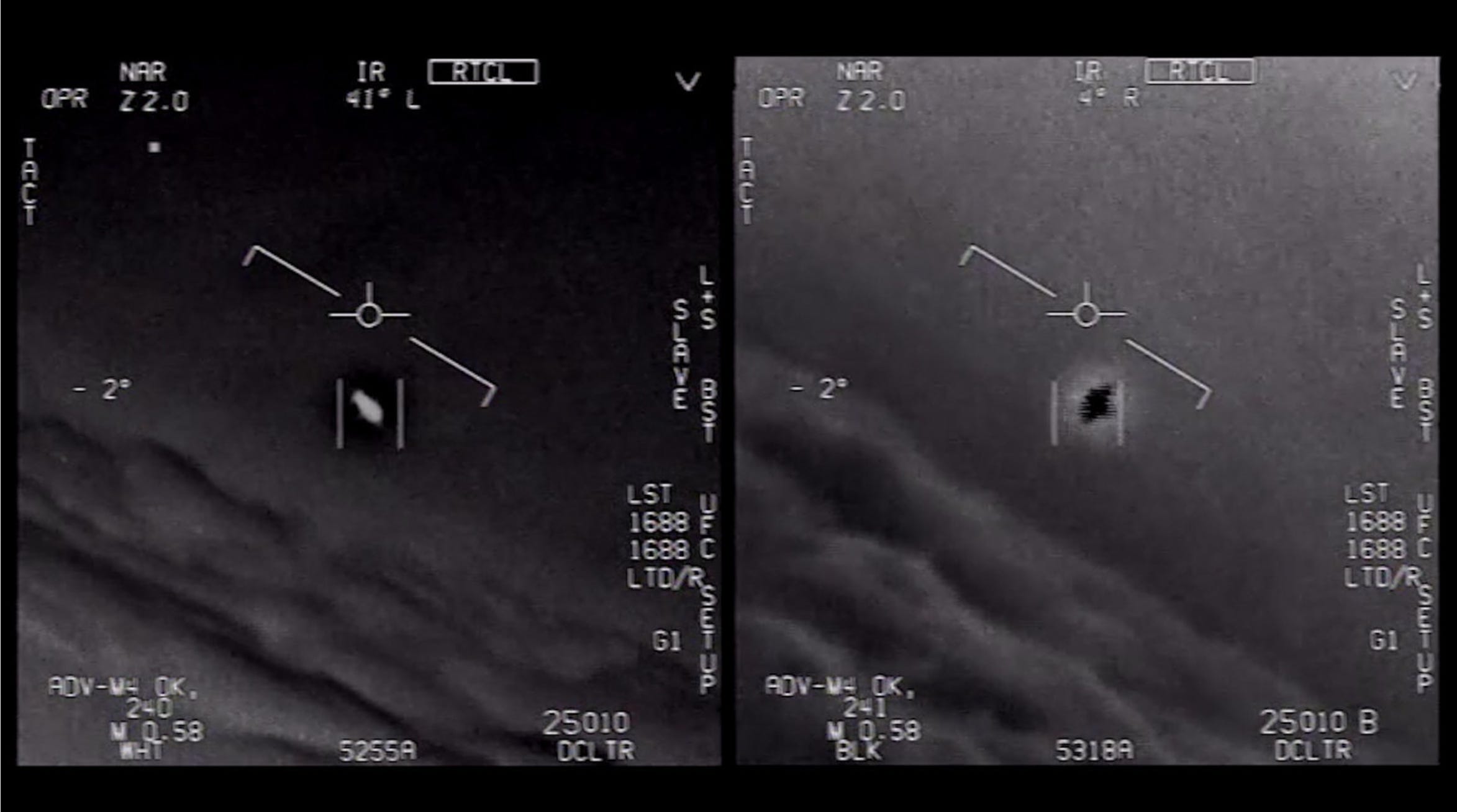
And it’s interdimensional
Modern theoretical physics already admits the possibility of compactified extra dimensions far below anything observable . These are not science fiction. They are taken seriously as mathematical structures by working physicists, even if their physical reality remains unconfirmed. McDonald’s way of looking at things would see that this compactification scale is itself a boundary condition of the theory, and he would ask whether this boundary condition has been properly constrained or whether we are, again, asserting it without adequate proof.
From beyond the grave, we can hear McDonald ask, what if the compactification scale of at least some extra dimensions is not fixed (e.g., at the Planck scale below the observable), but is itself a function of the local electromagnetic and plasma environment - specifically, of the charge density and chemical composition of the surrounding medium?
If this were true, then regions of anomalously high, stable charge density - such as the NO⁺ layers - would represent regions where the effective compactification scale of extra dimensions is locally modified. The three-phase boundary at the NO⁺ layer would then be not merely a chemical phase boundary but a dimensional phase boundary - a locus where the accessible dimensionality of spacetime transitions between values.
In precise terms: below the NO⁺ layer, spacetime is effectively 3+1 dimensional for all practical purposes. At and above the NO⁺ layer, the local plasma conditions modify the vacuum permittivity and permeability in ways that alter the effective boundary conditions on compactified dimensions, allowing - at sufficient energy density - transitions into a regime with different effective dimensionality.
It’s an interdimensional thermodynamic phase boundary engine
If the NO⁺ layer marks a dimensional phase boundary, and if topological transitions across that boundary are physically possible at sufficient energy density, then a technology that could control and localize such transitions - essentially, a technology that could create and manipulate a portable version of the NO⁺ phase boundary condition - would produce exactly the phenomenology described in credible UFO/UAP accounts.
Such a craft would not fly in any conventional sense. It would not push against a medium. Instead, it would carry with it a controlled phase boundary - a localized region in which the dimensional compactification condition is modified, allowing the craft to transition, at will, between the 3+1 dimensional regime of ordinary spacetime and a higher-dimensional regime in which the constraints governing inertia, momentum conservation, and electromagnetic cross-section are effectively different.
Transmedium transition without shock signatures because the craft is not moving through the medium in the conventional sense. It is transitioning between phase regimes at a boundary it carries with it. The surrounding medium does not experience a supersonic object passing through it; it experiences a local phase boundary forming and dissolving.
Apparent violation of inertial constraints because in the higher-dimensional regime, the effective inertial mass is not the same quantity as in 3+1 dimensional spacetime. The craft is not accelerating at thousands of g-force in the sense that would require a corresponding reaction force in our regime. It is transitioning between regimes in which the relevant conserved quantities are different.
Electromagnetic anomalies because the phase boundary itself, being a region of modified vacuum permittivity and charge density analogous to the NO⁺ layer, would produce anomalous radar cross-sections, luminous phenomena from plasma excitation of ambient NO and other species, and localized electromagnetic interference - all consistent with reported observations.
The NO⁺ connection with respect to UFO/UAP craft does not merely exploit the naturally occurring NO⁺ layer as a medium. Rather, the craft generates its own local NO⁺ analog - a shell or boundary layer of selectively ionized NO at precisely the thermodynamic conditions corresponding to the phase boundary minimum. This explains why UAP are sometimes observed to be surrounded by luminous plasma sheaths, and why NO and NO⁺ have the specific energetic properties they do: they are not incidental atmospheric chemistry. They represent the thermodynamic optimum for a phase boundary engine operating in a nitrogen-oxygen atmosphere.
A craft that operates by controlling a portable dimensional phase boundary is, in a rigorous mathematical sense, an object whose worldline passes through regions of spacetime with different effective dimensionality. It is not traveling from one universe to another. It is moving along a path that, in higher-dimensional configuration space, is continuous and smooth, but which, projected onto our 3+1 dimensional subspace, appears discontinuous.
It’s like a droplet undergoing a dewetting transition on a solid surface. If you watch only the contact line, you see a discontinuous topological change - the connected droplet becomes two separate droplets, or the droplet vanishes from the surface. But in the full three-dimensional description of the system, the transition is continuous. The apparent discontinuity is an artifact of watching only the projected, lower-dimensional representation.
Certain UFO/UAP phenomena exhibiting apparent discontinuities - sudden appearance, disappearance, relocation - are, in our “reconstructed” James E. McDonald framework from 55 years ago, exactly this: artifacts of our observation being confined to the 3+1 dimensional projection of a process that is continuous in higher-dimensional configuration space.
The UFO/UAP craft is a phase boundary engine operating at a thermodynamic optimum that the Earth’s atmosphere has been advertising, in the form of the NO⁺ layers, for as long as it has had a nitrogen-oxygen composition.
Firestorm: Dr. James E. McDonald’s Fight for UFO Science, Ann Druffel, 2003, Wild Flower Press.
https://www.sciencedirect.com/topics/engineering/young-equation
Exactly. I'm telling you, there's something strange about how my great grandfather "almost" won the Nobel for his work on plasma transition zones. He was studying bioluminescence and cytoplasm structure. Biology, not weapons. But how come 40 or so years later when Gilbert Ling made his big claims, everyone acted like they didn't know what he was talking about? Well, they didn't! Because all of the amazing biophysics has always gotten coopted and then classified for military usage. A lot of dots are lining up... Except where the missing people go.
But for real, what's up. Is the stuff at the bottom of this report from your work or this guys?
Synchronistic that I was just reading about Thomas Young, whose calculation of the contact angle of droplets on a surface was one of the least of his accomplishments. A prodigy and polymath, he coined the term "Indo-European languages", deciphered demotic ancient Egyptian script and nearly all of heroglyphics, quantified intrinsic material stiffness with Young's modulus, and most importantly proved the wave nature of light despite the British prejudice in favor of Newton's entirely wrong particle-propagation idea. (No, QM does not allow particle propagation at all, only discrete interactions and conserved quantities. Everything moves as waves.) Young was a Quaker, as was Dalton who put forth the atomic theory of chemistry. At the time, Quakers (the Darbys of Coalbrookedale) had also recently begun the mass production of iron, enabling the industrial revolution and started banking for the middle class and small businesses (Barclays, Lloyds and numerous other banks later merged with them.)
Your ideas on phase changes of spacetime are interesting, but I think likely UFOs are simpler in principle. String theory has been a dead end, the math is just wrong. The same is true of ~all physics since at least the 1920s, and what isn't false is misleading, I believe intentionally misleading. There are no compactified dimensions, any higher dimensions are in the nature of projective or conformal dimensions as in Conformal Geometric Algebra (5D (4,1) signature useful in computer graphics). Vector algebra is incomplete, Clifford Algebras with bivectors (oriented areas) and higher-dimensional entities was suppressed.
I suspect the actual mechanism of UFOs is more like waterdrops skittering on a hot pan, but with plasma taking the place of steam. The acceleration capability I suspect, uses interconversion of linear and angular momentum as seen in 3D, which are actually related by an additional ordinary dimension so that area/time of angular momentum in the higher dimension is projected down to distance/time in our space.
[My Physical Units Factor Tables (see my post) allows any beginning physics student to see how all physical quantities are related. My post on classification of Clifford Algebras demystifies higher dimensions, links to easily understood visual explanation of Geometric Algebra, the lingua franca of EM, QM, relativity and other areas of physics]